RESTORE 2025: Accelerating India’s Restoration Economy for a Harit Bharat
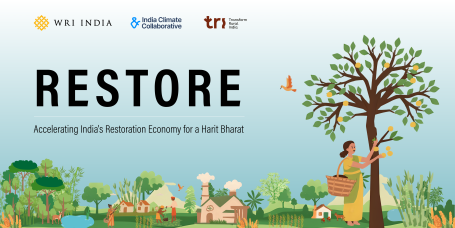
India’s diverse landscapes—forests, grasslands, commons, and agricultural lands—are the backbone of the nation’s ecological and economic well-being. Powering our food and forest-based economies, these landscapes sustain livelihoods for about 700 million people, especially poor and marginal communities, while providing vital ecosystem services such as clean water, fertile soil, food, fodder, carbon storage, and biodiversity conservation. Yet, almost 30% of India’s land is degraded, with agricultural areas (nearly half of this total) suffering from poor soil health due to unsustainable farming practices, increased fragmentation and degradation of forests and open natural ecosystems, monoculture in agriculture and forests. Climate change is further amplifying these impacts, resulting in more severe floods, droughts, and extreme heat and placing a disproportionate burden on vulnerable communities.
Why Restoration for Harit Bharat
Protecting and restoring India’s landscapes lies at the heart of this transformation. With over 100 million hectares of India’s total land offer potential for forest protection and landscape restoration, there is a significant opportunity to revitalize its natural capital and foster and support resilient, sustainable economic growth at scale. Investing in restoration solutions such as agroforestry, silvo-pasture, reforestation, assisted natural regeneration, restoration of commons and riparian areas, and sustainable agriculture strengthens both ecosystems and economies, as every $1 (~₹87) invested in land restoration can yield economic benefits of $7-30 (~₹600–₹2,500).
Building India’s Restoration Economy: From Barriers to Breakthroughs
India already has a growing momentum towards mobilizing finance, technology, and community capacity to scale impact on the ground. Progressive policies and global commitments like India’s pledge to restore 26 million hectares of degraded land by 2030 under the Bonn Challenge, Green India Mission (GIM) and Land Degradation Neutrality target under the Paris Agreement signal strong intent. Between 2011 and 2016, India invested over ₹1 lakh crore (about $13 billion, as converted on January 2022) in forest and tree cover improvement, mostly through the Mahatma Gandhi National Rural Employment Guarantee Act (MGNREGA), linking livelihoods and landscape restoration. Recent convergence frameworks like GIM–CAMPA and GIM–MGNREGS now enable coordinated public investment across ministries, ensuring restoration efforts are holistic and people-centered. These efforts are laying the foundation for a restoration economy that can advance India’s vision for Viksit Bharat@2047.
Complementing government efforts, Restoration Champions are driving this impact, as seen under the Land Accelerator South Asia (2020–23). However, they need access to capital and support to grow. Tailored financing, technical assistance, and stronger collaborative networks can help these models scale and achieve landscape-level impact—turning restoration into a resilient, investable sector that benefits people, nature, and the economy alike.
About Restore 2025
To accelerate India’s restoration economy through collective efforts, WRI India, India Climate Collaborative (ICC), and Transform Rural India (TRI) are co-organizing the RESTORE: Accelerating India’s Restoration Economy for a Harit Bharat, on December 3–4, 2025, at Shangri-La Eros, New Delhi.
This first-of-its-kind national dialogue will convene diverse stakeholders, including policymakers, philanthropies, investors, practitioners, entrepreneurs, and community champions, for two days of focused discussions, collaboration, and innovation.
These dialogues aim to:
- Explore opportunities in policy, finance, and business models and showcase innovative mechanisms that can unlock private and public investments.
- Facilitate cross-sectoral dialogue among national and state governments, financial institutions, and grassroots organizations to align priorities and co-create practical, equitable, and scalable restoration pathways.
- Showcase successful models and partnerships, such as community-led agroforestry, sustainable agriculture, riparian restoration, value-chain development, demonstrating how restoration can drive nature-positive growth and generate resilient livelihoods.
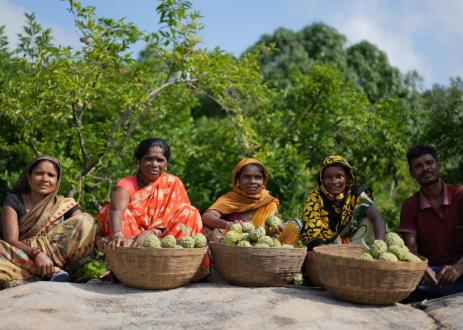
An accompanying exhibition will feature local Restoration Champions from across India who are restoring land, generating livelihoods, and strengthening ecosystem resilience.
Join us at RESTORE 2025
RESTORE 2025 is a platform to shape India’s restoration economy together – linking innovation, finance, and policy. Join us to reimagine this ‘Restoration for Harit Bharat’ for reviving landscapes, empowering communities, and building a greener, more resilient economy.
Projects
Protect & Restore
Visit ProjectCatalyzing locally-led restoration action to build a land-based restoration economy in India.
Part of Food, Land and Water