Transit-Oriented Development
Enabling Compact and Connected Cities
WRI India supports Indian cities in adopting spatial planning strategies based on the fundamental principles of land use and transport integration - an approach that promotes compact development and sustainable transport modes.
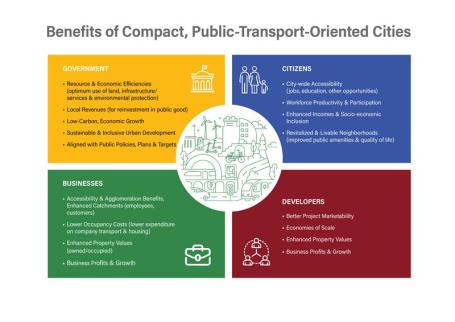
Research world-wide points to the high economic, social and environmental costs of automobile-oriented urban sprawl and conversely, the benefits of compact, public-transport-oriented cities. Investments in public transport can potentially create thousands of jobs and deliver economic returns 4–7 times the initial outlay. In India, smart urban growth can potentially save up to $1.8 trillion per year by 2050 – about 6% of the country’s GDP.
The Government of India (GoI) has set out a vision of Viksit Bharat, seeking to turn India into a $30 trillion economy and developed nation by 2047. It also aims to achieve carbon intensity reduction of 45% over 2005 levels by 2030, and net-zero emissions by 2070. Cities and transit-oriented development (TOD) strategies are fundamental to achieving these ambitions. While cities are expected to both accommodate and enable most of this growth, TOD helps decouple density from congestion, and economic growth from resource use and carbon emissions. TOD is a key urban development and climate action strategy, and its holistic adoption offers high dividends for sustainability and competitiveness.
Since 2011, WRI India has been contributing to the discourse and uptake of TOD in the Indian context through the following interventions.
Support to Plans and Policies
- Inputs into TOD policies, urban development guidelines at national/subnational levels, as well as city master plans and regulatory frameworks
- TOD vision and strategic plans at city or corridor scales
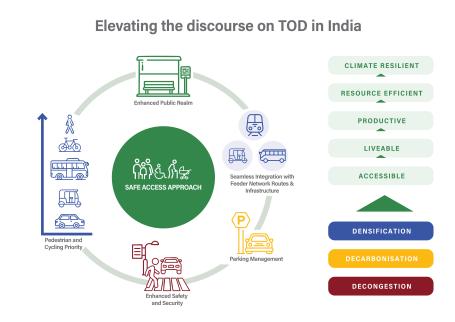
- Safe access and public space improvement plans at the station area or neighbourhood scales
Knowledge Sharing and Capacity Building
- Guidebooks and manuals or toolkits on integration of TOD policies or strategies into scales of plans (regional to local), liveable neighbourhoods and townships, form-based codes, and safe access to mass transit.
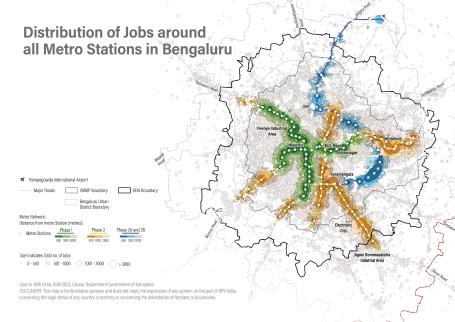
- Research papers and reports on synergising TOD and land value capture potential, enabling job densities, improving last-mile connectivity, and assessing TOD potential along transit corridors, managing high densities and parking regulations for station areas.
- Training modules and capacity building workshops on TOD planning and financing, road safety considerations in TOD projects, stakeholder sensitization and engagement workshops.
Resources
- Urban Land Value Capture in São Paulo, Addis Ababa, and Hyderabad: Differing Interpretations, Equity Impacts, and Enabling Conditions
- Land Value Capture Financing for Implementing TOD in Indian Cities
- High Level Convening and Roundtable Discussion on Enabling Transit-Oriented Development and Multimodal Integration Along Mass Rapid Transit Corridors in Bengaluru (Workshop Proceedings)
- Preparatory Activities for the Technical Assistance for Integrated and Sustainable Urban Development along Mass Rapid Transit Corridors in Bengaluru
- Realizing India’s Potential for Transit-Oriented Development and Land Value Capture A Qualitative and Quantitative Approach
- Integration of Road Safety Considerations in Transit-Oriented Development Projects
- Transit Oriented Development Manual: Delhi TOD Policy & Regulations Interpretation
- Indiranagar Station Accessibility Project and Development Control Regulations (SAP-DCR)
- Shaping Hubli-Dharwad as a “Connected” City
- Rethinking Off Street Parking Regulations Around Station Areas in Mumbai
- Shifting the TOD Discourse from Intensification of Built-up Area to Regulations Managing High People Densities in Mumbai’s Development Plan Revision
Safe Access Manual and Toolkit