

RESTORE 2025 Brings Stakeholders Together to Unlock India’s Restoration Economy for a Harit Bharat
Launched: New Working Paper Highlights Restoration as India’s Dual Climate Solution
New Delhi, December 3, 2025: In a step towards unlocking opportunities within India’s restoration economy, WRI India, in collaboration with the India Climate Collaborative (ICC) and Transform Rural India (TRI) Foundation, hosted “RESTORE 2025: Accelerating India’s Restoration Economy for a Harit Bharat.”
Speaking at the event, B.V.R. Subrahmanyam, CEO , NITI Aayog said, “Land degradation costs India 2–3% of GDP every year. For Viksit Bharat, we need consistent growth of around 8%, and reducing this degradation alone can add 2–3% to our GDP growth. Restoration is as powerful as a major economic reform.” He also added, “We often focus on climate mitigation and forget adaptation. Land and water are major carbon sinks, and improving land capacity accelerates carbon sequestration while helping India meet its 2070 net-zero goal without compromising growth. Restoration delivers both economic and climate gains.”
The RESTORE 2025 national convening brought together policymakers, researchers, civil-society organizations, businesses, investors and community leaders who are committed to advance India’s restoration economy and strengthen pathways toward climate resilience and green growth. The two-day event features high-level dialogues, technical sessions and an exhibition showcasing restoration solutions from across the country. The ‘Restoration Walkway’ presented the work undertaken by 12 Restoration Champions including Aadhimalai Pazhangudiyinar Producer Company, Under the Mango Tree Society and Lekope among others.
Highlighting the significance of locally led restoration action, Dr. Ruchika Singh, Executive Director, Food, Land and Water program at WRI India, said “Our Vision for Viksit Bharat@2047 is clear: it’s an opportunity to raise the ambition - to build a New Restoration Economy, where ecology and livelihoods grow together. A restoration economy spearheaded by local ‘Restoration Champions’ can create livelihoods while conserving and restoring nature, but to unlock its full potential we must bridge the finance gap and enable capital to flow to communities and enterprises leading restoration on the ground.”
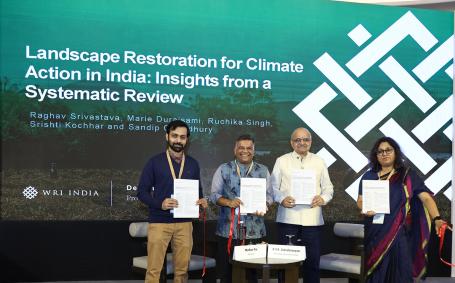
WRI India also launched “Landscape Restoration for Climate Action in India: Insights from a Systematic Review”, research that synthesizes 355 studies to assess how landscape restoration interventions such as agroforestry, afforestation, assisted natural regeneration and mixed plantations help in climate mitigation and adaptation.
Some key findings from the working paper include:
- Landscape restoration, especially agroforestry and afforestation/reforestation are one of India’s most effective strategies for achieving climate mitigation and adaptation.
- Agroforestry is the most widely studied and high-potential restoration intervention in India, accounting for 42.9% of all literature reviewed, and is strongly linked to both carbon sequestration and improved resilience for climate-vulnerable communities.
- Community participation is the single most critical factor in determining restoration success, appearing 168% more frequently than any other enabling condition in the reviewed literature.
At the event, WRI India shared a mobile-based Citizen Science Application that places communities at the centre of monitoring India’s landscape restoration efforts. Developed with field users in mind, the Citizen Science App is a bilingual (English and Hindi), Android and iOS-compatible platform that enables community members, local champions, and project staff to collect real-time, geo-tagged data on restoration interventions.
Highlighting the economic opportunity offered by landscape restoration, Shloka Nath, CEO, the Indian Climate Collaborative said, "Restoration is one of the strongest economic levers we have. Global evidence shows that every US$1 invested in restoration could generate returns of US$7–30, through improved productivity, resilience and livelihoods. For India, this is more than an environmental imperative; it is a strategic investment aligned with Harit Bharat and the economic aspirations of Viksit Bharat @ 2047.”
Anirban Ghose, Co-Founder and Co-lead, Transform Rural India said, “We are moving from isolated projects to landscape-level systems change with initiatives like Restoration for Harit Bharat signalling formal engagement with public ecosystems at scale. The ingredients for restoration have always existed, yet the gap between potential and outcomes remains wide.”
RESTORE 2025 aims to offer a platform to bring diverse stakeholders together and catalyse a national restoration movement and enabled embedding of restoration within economic planning, strengthening community-led models, and accelerating the transition toward a healthier, more resilient, and more prosperous India.
About WRI India
WRI India, an independent charity legally registered as the India Resources Trust, provides objective information and practical proposals to foster environmentally sound and socially equitable development. Through research, analysis, and recommendations, WRI India puts ideas into action to build transformative solutions to protect the earth, promote livelihoods, and enhance human well-being. Know more: https://wri-india.org/
About India Climate Collaborative
The India Climate Collaborative (ICC) is a collective working to drive funding towards climate solutions and enable funders to engage more effectively with climate action. The ICC works to connect its donor base with the climate ecosystem – including research organisations, implementers, government stakeholders, and more – to ensure that funding flows towards high-impact climate solutions. It was founded by some of India's pre-eminent corporate and philanthropic leaders, including Rohini Nilekani, Ratan Tata, Anand Mahindra, Sangita Jindal, and others. The ICC is legally registered as the Council of Philanthropies for Climate Action.
About Transform Rural India (TRI) Foundation
Transform Rural India (TRI) is a development design organisation dedicated to transforming India’s 100,000 most stranded villages into flourishing communities. By leveraging a convergence model that brings together government (sarkar), society (samaj) and markets (bazar), TRI facilitates systemic and scalable change through its unique Thoughtful Tarakki strategy – an approach focused on community-led regenerative development.