


Connect Karo 2025: Bringing Stories and Stakeholders Together
As heavy showers inundated New Delhi, over 2,000 guests and speakers navigated waterlogged streets and traffic snarls to participate in Connect Karo 2025. The gravity of the climate crisis and the urgency to adapt was present in every room and hall, as leaders, decision-makers, peer organizations and other stakeholders convened to discuss the critical climate and development challenges facing India.
To see such a turnout, even in such difficult weather, inspires hope in the ability of communities and people to drive change. We really enjoyed the diversity of voices and depth of discussions and are committed to hosting Connect Karo every year.
- Madhav Pai, CEO, WRI India
The two-day event saw the power of collaboration as participants across the board shared experiences and learnings. “This is my first time at Connect Karo, and the diversity of people on a single platform is so inspiring,” Shruti Goel, Co-CEO of Upaya Social Ventures shared. “You have grassroot organizations and leaders talking about policy at scale. Then, there are sessions looking at implementation, delving into innovative topics like climate financing and really taking a problem-solving approach,” she added.
Emphasizing the importance of collaborating with rural communities and enabling a shift in perspective, Arti Dhar, Co-Founder, Farmers for Forests, spoke about the success of the payment for ecosystem services model for financing conservation, “We need people to feel that it is worth keeping green assets alive on their land as opposed to cutting trees.”
Building Resilience from Cities to Farms
Rising heat and flooding hazards took center stage at Connect Karo 2025. At the session on “Data as an Enabler of Flood Management and Planning,” panelists discussed challenges, effective strategies and the role of data-driven decision-making in strengthening urban resilience. During a session on “Improving Heat-Health-Housing Outcomes,” Shalini Sinha from WIEGO, pointed out how “home-based workers and female wage earners suffer from economic losses during summer months.”
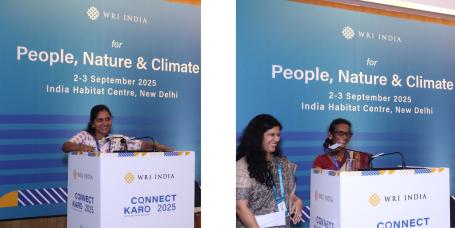
Farmers, like many others, also face significant hardship due to extreme heat and rain. “Earlier we would grow soybean and some other crops, but it was repeatedly ruined by pests. Now most farmers in our area grow maize. It is a more resilient crop whether there is excess water or shortage,” said Shiv Kumari Verma, a farmer who is leading tikau kheti (sustainable agriculture) efforts in Madhya Pradesh’s Chhindwara District. “Recently, there was a shortage of urea in our region. The farmers associated with us were using organic fertilizers and did not face any of those problems,” Shiv Kumari beamed as she shared the story during a session on “Women in Agriculture: Closing the Gender Gap for Transitioning to Sustainable Agriculture.”
Adaptation and Skilling in Indian MSMEs
In India’s MSMEs, the losses pile up as the rain falls. During the November 2015 cyclone in Chennai, factories in Ambattur were flooded overnight. “We didn’t know what to do, the entire supply chain stopped. Original equipment manufacturers (OEMs) started shifting our orders to other states,” Dr. Verchezhian VSV, Managing Director of Shri KVS Industries shared. “After 2015, we studied why the flood is coming and took measures. Factory owners are raising their floors, and we also emphasize insurance for MSMEs,” adds Verchezhian, who is also State President for Laghu Udyog Bharati, Tamil Nadu.
Heat brings its own challenges for workers, as per Raghav Dalmia, Director of Surat-based Prayagraj Dyeing & Printing Mills. “The discomfort workers feel while working in heated environments can lead to respiratory and heart-related issues.” Both Raghav and Dr. Verchezhian spoke at a session on building the resilience of MSMEs, where discussants focused on planning climate-resilient infrastructure, and the need for finance and small insurance instruments.
The women we have trained are breadwinners of their family. They wanted to have a full-time job in a safe environment that improves their situation. Consequently, even as the training is happening, we try and ensure their income does not stop.
- Sivasankari TP, Founder and Managing Director, AR4 Tech
As the transition to low-carbon technologies happens across key sectors, there is a critical need to equip workers with green skills, as discussed during a plenary session on “Skilling for a Green Future.” People like Sivasankari TP, Founder and Managing Director of AR4 Tech, are setting an example by training rural women to convert Internal Combustion Engine Vehicles (ICEVs) into EVs, “We designed trainings that are practical-oriented for women who have no formal education.” The demand to want to participate emerged from the women themselves, who now comprise close to 20% of AR4 Tech’s workforce.
Toward a Green Transition for India
Underscoring the many diverse voices and conversations were our key plenary sessions where decision-makers discussed and addressed the larger issues of transitioning towards sustainable models of urbanization and unlocking finance to enable green transitions.
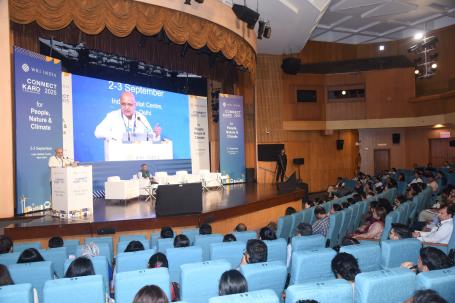
Speaking at the plenary session on “Financing India’s Transition,” BVR Subrahmanyam, CEO of NITI Aayog said, “Despite contributing only 3-4% of cumulative global emissions, India is among the most climate vulnerable nations, facing devastating floods, heatwaves and other impacts every year. The challenge is in making projects viable to unlock the trillions needed for a green transition.”
Dr. Debolina Kundu, Director at National Institute of Urban Affairs (NIUA), emphasized the significance of urban policies during another plenary session and noted, “Around 35% of India’s population is urban, one-third is rural, and the rest lives in transitional spaces. This is where state urban policies become crucial — by identifying transitional areas and adopting definitions that are more dynamic and future-ready.”
Fostering Hope and Sharing Stories

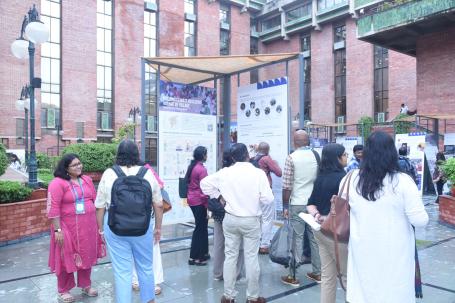
Even as policy discussions took center stage, passersby found themselves drawn to “Stories That Matter,” an immersive exhibition held on the sidelines of Connect Karo. Spotlighting stories of resilience and hope across the country, the exhibition resonated with visitors, highlighting the critical role storytelling plays in “bridging gaps and igniting change,” in the words of Urusha Iram, one of the attendees. Ashirbad S Raha, Regional Communications Director at EPIC India, felt that while climate conversations can often feel abstract, initiatives like “Stories That Matter” help “ground us in the lived realities of people driving change. They show us that climate action is not just about technology or policy — it’s also about people, their choices, their courage and their innovation.”
As we reflect on insights from the many informative and compelling conversations and experiences that were shared at the event, we keenly look forward to how these learnings will shape our work and our world.