


How Common Facility Centers Can Drive a Just EV Transition
Imagine a group of enterprises spread across an industrial estate, eager to manufacture components for electric vehicles (EVs) but constrained by the cost and complexity of advanced high-end machines and testing facilities. For most micro, small and medium enterprises (MSMEs), such equipment and training are hard to come by and difficult to afford. As a result, they risk being excluded from emerging EV supply chains.
This is where a Common Facility Center (CFC) comes in. Serving as a shared space for modern manufacturing, CFCs bring together advanced equipment, skilled technicians and training support under one roof, enabling even small enterprises to compete and innovate in the evolving EV landscape.
The Case for Shared Facilities
Automotive clusters in India, such as Pune, Faridabad, Chennai, Chhatrapati Sambhajinagar and Coimbatore have long specialized in combustion-engine parts. As vehicle manufacturers pivot to EVs, MSMEs in these clusters must adopt new capabilities.
However, the cost of the equipment needed for EV manufacturing can be quite high. The average cost of machines such as high-precision computer numerical control (CNC) mill, battery test chamber or dynamometer can exceed ₹50 lakh each, with an additional annual maintenance cost of over ₹10 lakh. Enterprises with annual turnovers of ₹1–2 crores cannot afford this.
Common facility centers for EV manufacturing offer a practical solution by providing shared access to machines and expert support. Instead of purchasing expensive equipment, entrepreneurs can block slots, pay per use, and get specialized support for operation and calibration. This lowers financial barriers, increases operational efficiency and raises technical standards across the cluster.
Many countries have demonstrated the value of shared facilities. In Germany, MSMEs in Baden-Württemberg rent central testing labs by the hour to comply with strict EU standards. In China, startups in Zhejiang EV Innovation Park use shared 3D printing and CNC prototyping facilities to accelerate design and testing without incurring massive capital outlays. South Korea also relies on shared laboratories to maintain global competitiveness and support supplier clusters.
Benefits of Common Facility Centers for MSMEs
Shared infrastructure offers a range of tangible benefits. From improving quality standards to reducing operational risks, the gains extend far beyond cost savings.
Consistent product quality: Shared laboratories offer standardized testing, calibrated instruments and trained staff, which helps ensure consistency in product quality. This inspires trust among domestic supply chains as well as global buyers.
Promote capability-building: EV manufacturing requires new digital tools, simulations and testing processes that take time and training to master. A well-run CFC can offer regular workshops on topics like torque ripple control, battery safety testing and basic CAD/CAM design. Enterprises can share knowledge, skills and solutions across the cluster. For instance, when one enterprise finds a way to reduce motor vibration, others also stand to benefit.
Cost-sharing encourages innovation and faster iteration: By accessing shared facilities, such as 3D printers or CNC machines, at the CFC, small businesses can quickly prototype and test new designs without waiting months or investing in costly equipment. This affordable, trial-and-error approach, which generally costs just a few thousand rupees, helps MSMEs test products faster, in smaller batches, catch design flaws at early stages and reduce scrap. It also allows these enterprises to explore high-value opportunities such as microcontrollers or smart sensor assemblies.
Ecosystem development: A well-equipped CFC can draw new investment and skilled workers to the cluster. As more MSMEs start producing EV components, related enterprises that are involved in magnet coating and wire harness tend to set up nearby, creating a strong local ecosystem. Skilled workers also tend to stay on, which boosts the skills and job opportunities in the region.
Why India Needs CFCs Now
Indian automotive clusters specialize in low-technology mechanical automotive components – such as engines, exhausts and gearboxes. But as original equipment manufacturers (OEMs) shift to EVs and the demand for these parts shrinks, Indian MSMEs risk being left behind. With EV manufacturing demanding accuracy, certification and modern infrastructure, CFCs tailored for EV MSMEs can act as a strategic enabler for India.
The concept of CFCs is not new to India. Under the MSME Ministry’s Cluster Development Programme (MSE-CDP), CFCs have worked well in sectors like textiles and foundries. By giving small-scale units access to advanced tools and certified labs, CFCs can turn clusters into future-ready manufacturing ecosystems capable of powering India’s clean mobility goals.
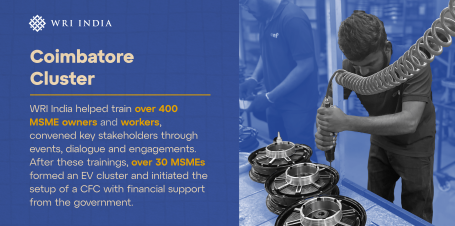
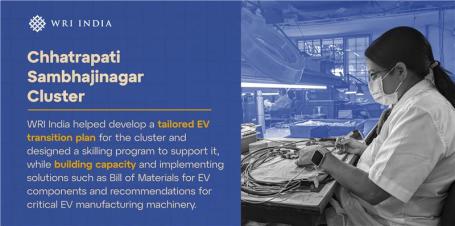
This shift is already taking shape in cities like Coimbatore and Chhatrapati Sambhajinagar, where WRI India, in collaboration with local partners, is helping MSMEs prepare for the EV transition. With government support, CFCs are being set up in both clusters, offering MSMEs shared access to advanced machines and design tools.
Designing and Managing CFCs
When designed thoughtfully, CFCs can become self-sustaining institutions that serve clusters for decades. Accountable management plays a key role in their success. Typically, a committee of cluster members oversees the selection of equipment and pricing. Transparent digital booking systems can help ensure fair and efficient access. While seed funding may come from government or development agencies, a sustainable CFC can operate on steady revenue through membership fees, hourly usage fees and training income.
CFCs offer a promising solution to bridge the gap between current capacities and the standards being demanded by EV supply chains. With the right policies, partnerships and management, they can enable MSMEs to upgrade, learn, innovate and thrive in new supply chains, paving the way for a just transition in India’s automotive industry.